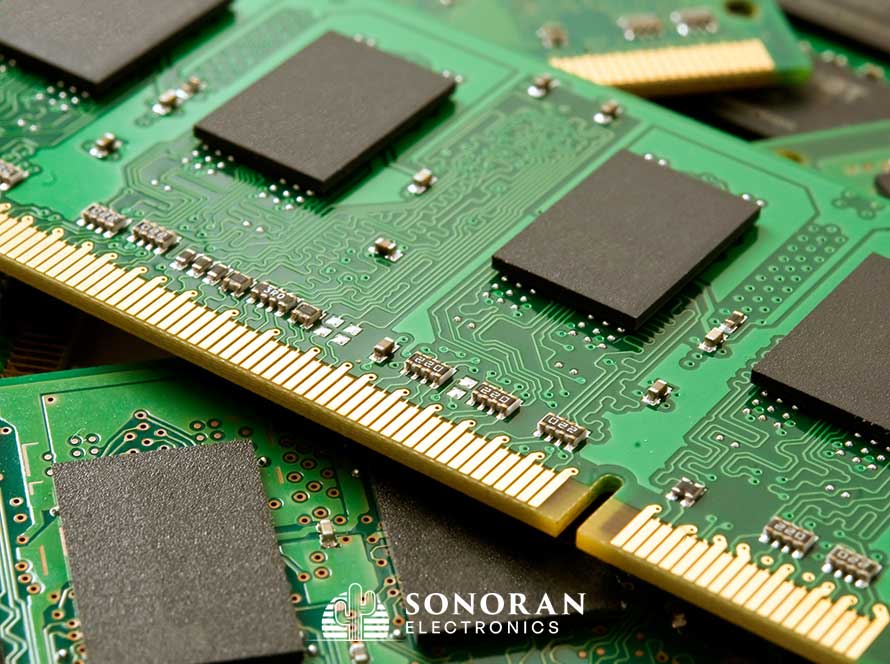
As artificial intelligence continues its rapid evolution in 2026, a major transformation is occurring: intelligence is migrating from centralized data centers to edge devices. This shift is reshaping the microelectronics landscape, creating demand for specialized chips and components that can process AI workloads locally—with minimal latency, low power consumption, and strong security guarantees. Edge AI is no longer an emerging concept; it is becoming a central pillar of next‑generation computing across industries.
Edge AI refers to systems that execute machine learning inference (and in some cases lightweight training) on the device itself, rather than relying on continuous communication with a cloud server. This capability is critical for applications where responsiveness and reliability are paramount, such as industrial automation, autonomous vehicles, robotics, smart sensors, and consumer electronics like smartphones or wearables. According to industry forecasts, the global edge AI chipset market is projected to grow from roughly $5.3 billion in 2024 to over $22.9 billion by 2030, driven by demand for localized, energy‑efficient intelligence.
The technical demands of edge AI are distinct from those in data‑center environments. Where cloud systems prioritize raw performance and scale, edge platforms must balance power efficiency, heat management, size constraints, and cost. These requirements have led to the proliferation of specialized microelectronic architectures tailored for edge workloads. Examples include neural processing units (NPUs) embedded within system‑on‑chips (SoCs), low‑power GPUs, and highly optimized digital signal processors (DSPs) that excel at convolutional and matrix operations common in AI inference.
Leading semiconductor designers are integrating these capabilities directly into mobile SoCs. For instance, smartphone and tablet platforms increasingly include dedicated NPUs and AI accelerators capable of handling vision processing, natural language commands, and biometric functions without cloud dependency. Similarly, automotive SoCs now include AI acceleration blocks that process sensor fusion, object detection, and path planning locally in real time—critical for safety‑critical decision making.
Materials and packaging innovations are also playing a role in enabling edge AI. As clusters of AI cores and memory are integrated into tighter footprints, advanced packaging methods like fan‑out wafer‑level packaging (FOWLP) and chiplets interconnected through high‑density interposers help reduce power usage and improve bandwidth between components. These packaging strategies can dramatically improve thermal performance and functional density in compact form factors, making them ideal for edge devices where space and energy are at a premium.
Another dimension of edge AI’s growth is software‑hardware co‑design. Modern toolchains and compilers — such as TensorFlow Lite, ONNX Runtime, and vendor‑specific SDKs — translate high‑level neural network models into optimized code that runs efficiently on edge accelerators. This cooperation between software and silicon ensures that applications can leverage the full potential of the underlying microelectronics without bespoke low‑level programming.
The implications for microelectronics buyers, designers, and integrators are significant. Procuring edge‑optimized components now involves more than selecting a traditional microcontroller or processor; it increasingly means evaluating AI acceleration capabilities, power envelopes, thermal constraints, and software ecosystem support. System architects must weigh trade‑offs between edge AI inferencing performance, device cost, energy consumption, and end‑user responsiveness.
From a broader supply‑chain perspective, the rise of edge AI is creating new segmentation within the semiconductor industry. Suppliers of specialized low‑power accelerators, optimized memory hierarchies, and advanced packaging solutions are seeing demand growth that is decoupled from traditional laptop or server markets. As a result, microelectronics procurement strategies are evolving to consider edge‑specific requirements — such as extended operating temperature ranges, long‑lifecycle support (critical for industrial edge deployments), and regional availability for localized production.
Edge AI is a defining trend in 2026 that is reshaping how intelligence is delivered and experienced. By bringing AI closer to where data is generated, microelectronics designers and buyers can unlock faster insights, stronger privacy protections, and more resilient system behavior across a wide range of applications. For anyone engaged in sourcing, designing, or deploying edge‑optimized components, understanding the implications of edge AI on performance, power, and cost will be essential in navigating the next wave of embedded intelligence.